This tiny gem grew to 268 stars and 112 forks, with 32 contributors over 7 years. It learned Bootstrap 3, then 4 with auto-detection (v1.6.0), got a non-Rails mode with
dataConfirmModal.confirm() callbacks (v1.2.0), an npm package still pulling 3,700 downloads/week (v1.6.2), and kept working with every Rails version through 6.0. The concept became so mainstream that every UI framework now ships its own confirmation dialog component. The repo is still up.
A user at IFAD did too much damage last week.
Not maliciously — they just clicked through a chain of destructive actions, happily dismissing the browser’s confirm() dialogs without reading them. Because nobody reads those. They’re ugly grey system dialogs that blend into the background of your workflow. Click OK, click OK, click OK — and suddenly half the data is gone.
So I fixed it. And then I extracted the fix into a gem, because this problem isn’t specific to our application. Today I’m releasing data-confirm-modal — 116 lines of JavaScript that replace Rails’ built-in confirm() with a Bootstrap modal.
The fix
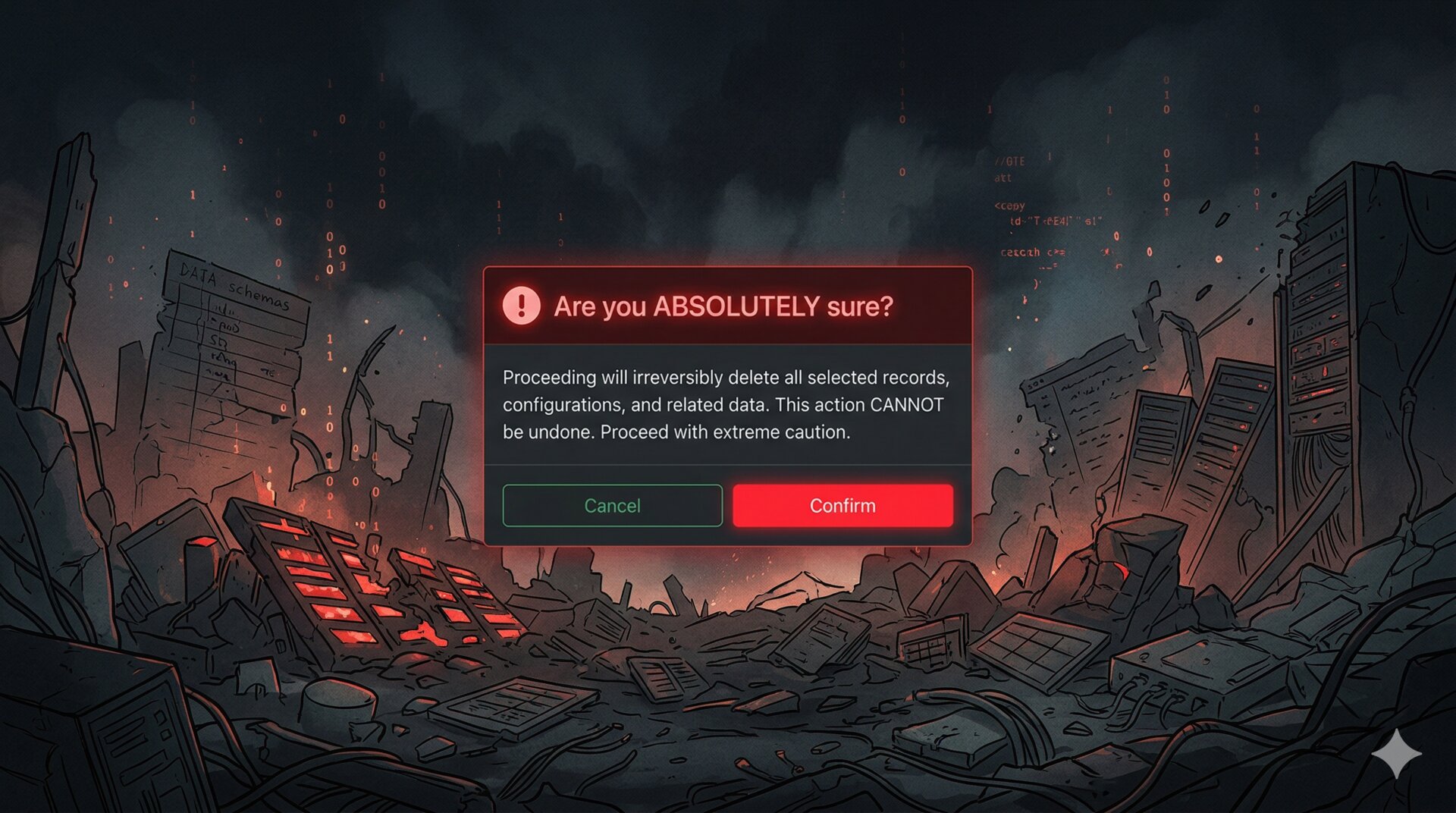
The concept is dead simple: any Rails link with data-confirm already triggers a browser confirmation. My gem intercepts that event and shows a proper Bootstrap modal instead. The title defaults to “Are you ABSOLUTELY sure?” — because apparently we needed to be louder.
Drop-in replacement. Zero changes to your existing code. Add the gem, require the JS, and every link_to "Delete", @thing, confirm: "This will destroy everything" now pops up a real modal with a title, a body, and two clearly labeled buttons.
# Gemfile
gem 'data-confirm-modal', github: 'ifad/data-confirm-modal'
// application.js
//= require data-confirm-modal
That’s it.
The data-verify trick
Here’s the feature I’m most proud of. You know how GitHub makes you type the repository name before you can delete it? Same idea:
<%= link_to "Delete project", project_path(@project),
  method: :delete,
  data: {
    confirm: "This will permanently delete the project and all its data.",
    verify: "DELETE",
    commit: "I understand, delete it"
  } %>
The confirm button stays disabled until the user types exactly “DELETE” into the input field. No more muscle-memory clicking through destructive actions. If you want to destroy something, you have to prove you mean it.
How it works
The interesting bit is the integration with Rails UJS. When a data-confirm link is clicked, Rails fires a confirm event and checks $.rails.confirm() to decide whether to proceed. My code temporarily monkey-patches that function:
$(document).delegate('a[data-confirm]', 'confirm', function (e) {
  var element = $(this), modal = getModal(element);
  var confirmed = modal.data('confirmed');

  if (!confirmed && !modal.is(':visible')) {
    modal.modal('show');

    // Temporarily replace Rails' confirm function
    var confirm = $.rails.confirm;
    $.rails.confirm = function () { return modal.data('confirmed'); }
    modal.on('hide', function () { $.rails.confirm = confirm; });
  }

  return confirmed;
});
Show the modal, swap the confirm function, restore it on hide. When the user clicks the confirm button in the modal, modal.data('confirmed') becomes true, the original click is re-triggered, and this time $.rails.confirm returns true. Clean, minimal, no jQuery UI dependency.
The damage that started it all
The actual incident at IFAD involved a user managing project data in our internal applications. The browser’s confirm() dialog had become invisible to them — just another speed bump to click past. The data they deleted took significant effort to recover.
The fix in our application was immediate: swap confirm() for a modal that demands attention. The extraction into a gem took three commits and six minutes. Sometimes the best open source comes from the worst production incidents.
Source on GitHub. Check it out on JSFiddle. PRs welcome — especially if you’ve also been burned by confirm().