🍸 New here? Not an IRC post — but the same itch to dig up my old code led me to reboot IRC itself for 2026. Click here to go back to 1995 → · or read why I’m doing this →
In February 2002 I was 20 years old and taking a Programmazione (Programming) exam. The assignment was: a data structure representing books, stored as binary records in a file. Write a program to list, add, and delete them.
I didn’t do that. I built a graphical calculator instead.
What the assignment asked for
The professor wanted a record of type Book — title, author, year, price — written sequentially to a binary file with BlockWrite. A menu: list all books, add a book, delete by index. Maybe search. The kind of program where the hardest part is remembering that Turbo Pascal file offsets are zero-based.
I found this boring.
What I built instead
GRcalc is a function plotter. You type a mathematical expression — sin(cos(x)), ln(cos(x*x)) + atan(x), anything composable from trig, logarithmic, and arithmetic operations — and it draws the curve in real time on a Cartesian plane with labeled axes and zoom control.
It ran in 640×480 BGI graphics mode, with drivers for EGA/VGA, CGA, and Hercules linked directly into the executable so there was nothing to distribute besides the .EXE.
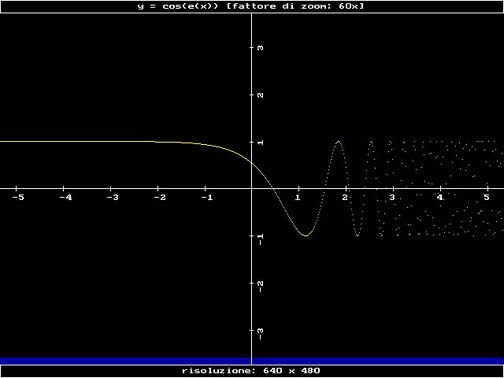
Here’s y = cos(e(x)) at 60× zoom:
And y = ln(cos(x*x)) + atan(x) at 90× zoom — a more complex composite function with discontinuities where cos(x²) goes negative:
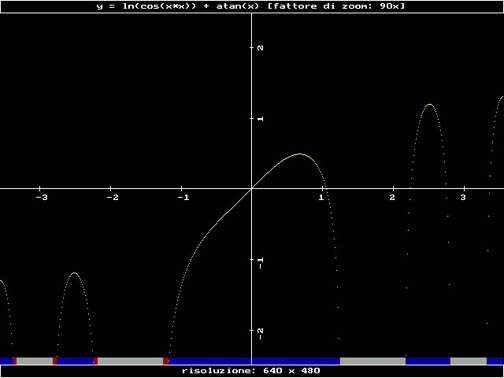
The progress bar at the bottom was color-coded: blue where the function is defined, red where it’s defined but off-screen, gray where it’s undefined (like ln of a negative number).
How it works
The program has three layers: a parser, an evaluator, and a renderer. The full source is ~1000 lines of Turbo Pascal in a single file.
The parser
A state machine that walks the input string character by character and builds a linked list of typed terms. Each term is either a number, a variable (x), an operator, a function name, or a bracket.
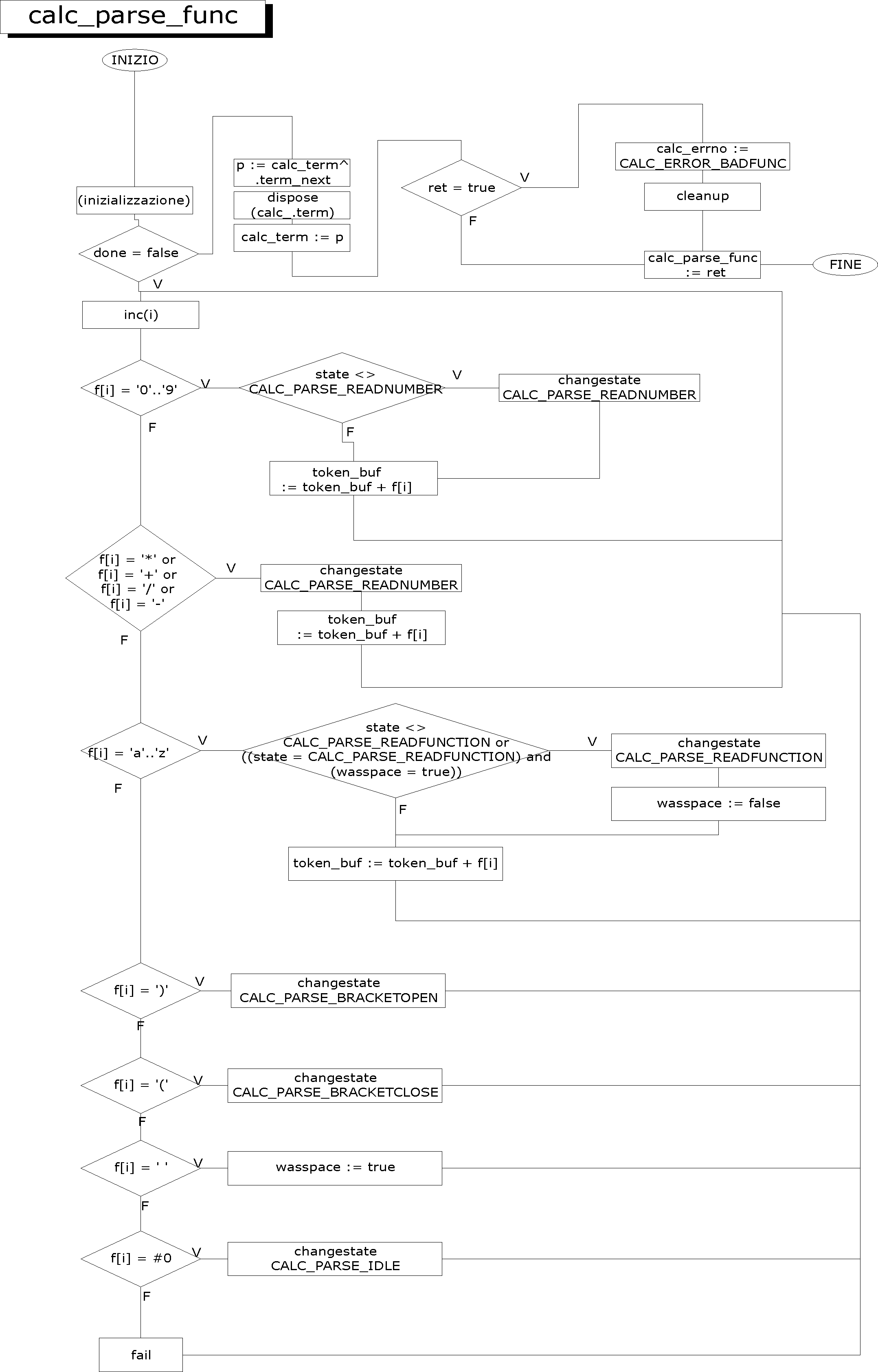
Every state transition validates syntax — you can’t have two operators in a row, a function must be followed by an expression, brackets must balance. If anything fails, the parser sets calc_errno and bails out.
The function lookup uses a dispatch table — an array of records mapping name strings to function pointers:
calc_func_table : array [1..CALC_FUNX] of record
    func_name : string[5];
    func_handler : calc_func_handler_t;
end = (
    (func_name : 'sin'; func_handler : calc_sin),
    (func_name : 'cos'; func_handler : calc_cos),
    ...
);
Same pattern for operators. Adding a new function meant one line in the table and one wrapper procedure.
The evaluator
The heart of the program is get_y_value — a function that takes an x value and walks the linked list, evaluating the expression.
The trick is mutual recursion. get_y_value handles the top-level evaluation loop (numbers, operators, variables). When it hits a function term, it calls evaluate_func, which grabs the function pointer, advances to the next term, and recurses: if the next term is another function, it calls itself; if it’s a bracket, it calls back into get_y_value for the sub-expression.
This is how sin cos tan x worked — evaluate_func chained three calls deep, each one wrapping the next, until it hit the variable and unwound: sin(cos(tan(x))).
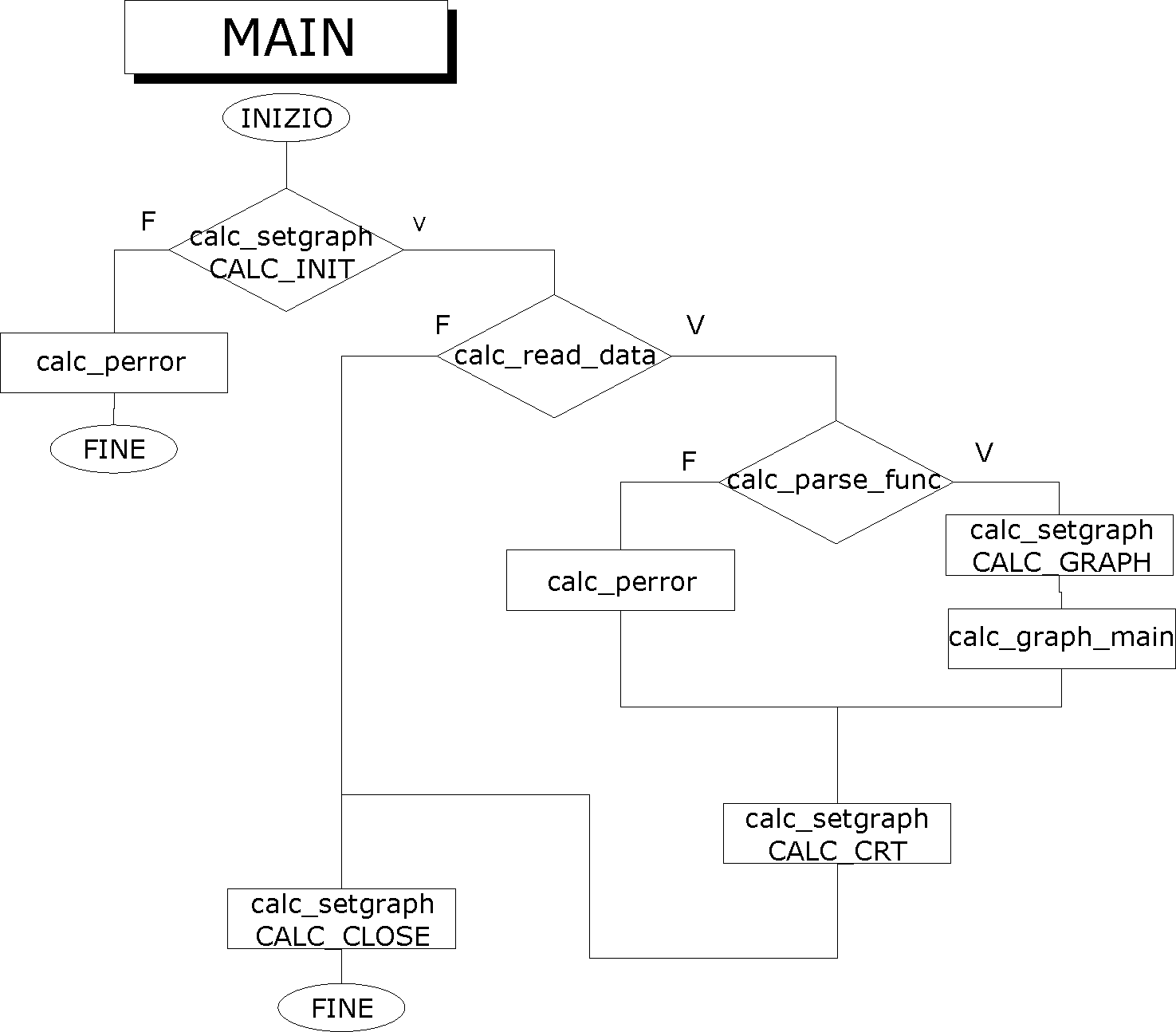
The renderer
For each pixel column on screen, the renderer called get_y_value with the corresponding x (divided by the zoom factor), scaled the result, and plotted a yellow pixel. If the function was undefined at that point — ln of a negative number, division by zero — calc_errno flagged it and the progress bar turned gray. If the value exceeded the viewport, the bar turned red.
The Cartesian axes were drawn with tick marks and labels that adapted to the zoom factor. The top bar showed the function and zoom level, the bottom bar the resolution.
Error handling
I was in love with C’s perror(3) at that point in my life, so I built a miniature version: a global calc_errno, an array of error strings, and a calc_perror procedure that printed the message. Division by zero, undefined domain, syntax errors, graphics init failure — they all went through the same path.
What’s honestly wrong with it
I wrote 10 pages of documentation with flowcharts drawn in CorelDRAW, plus 26 pages of printed source code — we had to bring it all in printed form. I compiled a 52KB executable that detected the video card and plotted arbitrary math functions in real time. But reading the code now, twenty-four years later, there are real problems:
No operator precedence. 2 + 3 * x evaluates left-to-right as (2 + 3) * x. The parser doesn’t build an AST with precedence levels — it builds a flat linked list. You need brackets for correct math: 2 + (3 * x). I knew — I was running late and parentheses worked fine.
Integers only for constants. You can’t type 3.14 * x because the parser only handles digit characters. No decimal point support. Want π? Use atan(1) * 4 * x. Or don’t.
Everything is global state. calc_errno, calc_term, calc_zoom — all global variables. The evaluator mutates its pointer argument as a side effect to track position in the linked list. It works, but it’s the kind of code where adding a second feature breaks the first one.
The calc_term_t record wastes memory. Every node in the linked list carries fields for a number value, a function pointer, AND an operator pointer — even though each node is only ever one of those types. I actually discuss this in the comments, consider using objects with inheritance, and decide it would make the program “too complex.” At 20, I was right for the wrong reasons.
The bug on line 655
In evaluate_func, the NUMBER case reads p^.term_next^.term_value — that’s the next node’s value, not the current one. It should be p^.term_value. This never triggers in practice because you’d have to write something like sin 5 (a function applied to a literal number without brackets), and nobody does that — you write sin(5) or sin x. A real bug, hidden by convention. I never caught it in 2002. Claude found it in 2026.
delay(100) between pixels. Every pixel gets a 100ms pause so you can watch the curve being drawn. Seconds of forced animation for each plot, no way to skip it.
The exam
I brought this to the exam on February 20, 2002. Ten pages of documentation and twenty-six pages of printed source code, flowcharts, a working executable. The professor looked at it. She was expecting type TBook = record. She was expecting BlockWrite and BlockRead and a text menu that says 1) Aggiungi libro 2) Cerca libro 3) Esci.
She got a state machine parser, function pointer dispatch tables, recursive evaluation with mutual recursion, and real-time graphics rendering.
She said: “I don’t understand anything from this code. I don’t know how to judge it. What’s your previous exam score?”
“24 out of 30.”
“I can give you 25.”
I took the 25. Any score was fine for the intrinsic value of the work. I knew what I’d built.
What happened next
I left the university after that. Not dramatically — I just stopped going. The gap between what I was learning on my own (parsers, graphics, networking, IRC servers) and what they were teaching me (books in binary files) was too wide. I went back a few years later and left again, but that’s another story.
The code sat on barnaba.openssl.it for the next twenty-four years — a static page I put up as a student and never took down. Today I’m putting it on GitHub where it belongs.
GRcalc is not good software. It has bugs, no operator precedence, hardcoded delays. But it’s an honest artifact of what a 20-year-old who read too many man pages and not enough textbooks could build when he decided the assignment was boring.
25/30.
🍸 grappa is live. That calculator never shipped. This one did. Pick a name, click into a chatroom, and you’re back in 1995 — no app to install, no account to make. Step into IRC at grappa.chat → · the why →