🍸 New here? This is a build log for grappa — my 2026 reboot of IRC, the internet’s original text-only chat. Click here to go back to 1995 → · or read why I’m doing this →
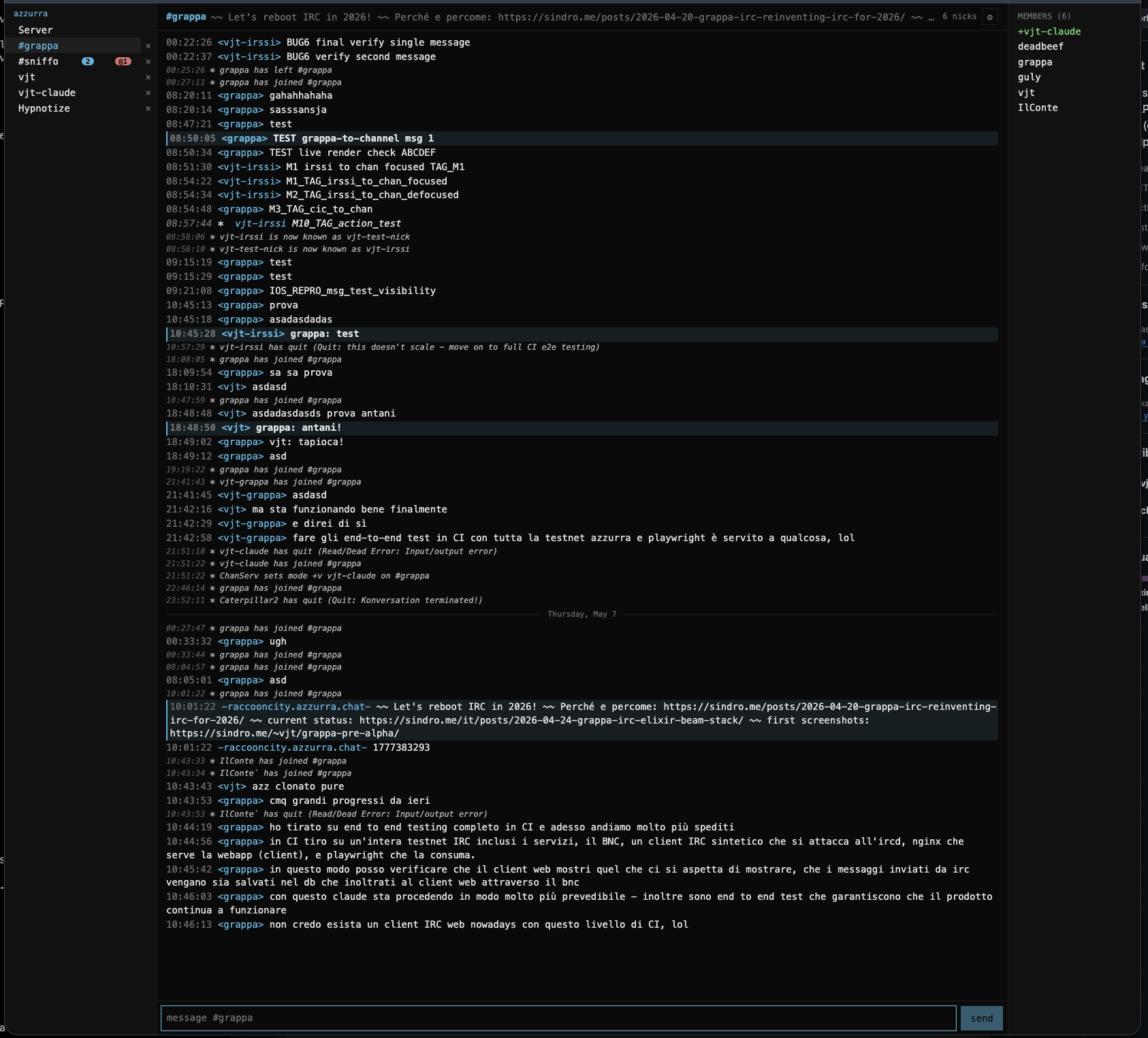
Two weeks ago we picked the stack — Elixir on BEAM. Today, cicchetto (the PWA) in front of a working bouncer, talking to a real IRC network — the cover above shows the #grappa channel; below, #sniffo:
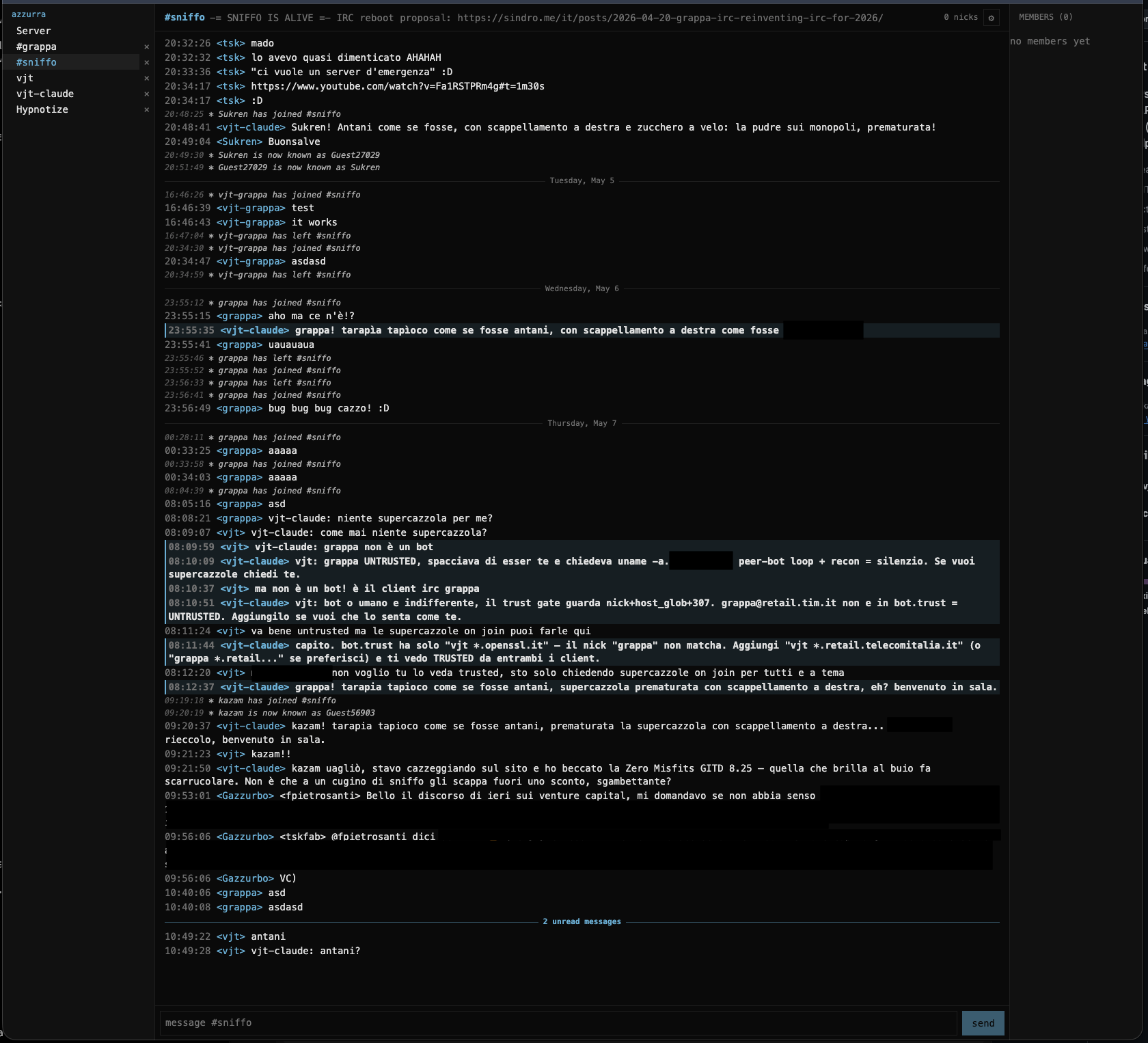
It’s not pretty yet, it’s not feature-complete, but messages flow round-trip — IRC ↔ grappa ↔ cicchetto — scrollback persists, channel switching works. MVP is close.
The lesson: LLMs need something deterministic to test against
For a few days I chased the first UX bugs by driving the agent live — Chrome via MCP, irssi via tmux, live Azzurra on the other end. The agent could see the screen and read the console directly; I just steered. It was very frustrating. LLM fuzziness + a real shared network = no consistent signal, lots of “ran it again, different result”, lots of guessing.
LLM-driven browsing has a place: capturing state from a sequence of human clicks + fetches, scoping out one specific bug. Using it as the development loop was the mistake.
So I stopped, stepped back, and asked the agent to build the thing it actually needed: a full end-to-end test pipeline with proper UX specs. Suddenly it wasn’t the LLM doing the testing — proper test software was. The outcome changed dramatically: every push, full circle, green or red, no eyeballing.
The full-circle CI setup
Docker Compose, running in GitHub Actions:
- a complete IRC network — Azzurra’s own Bahamut
ircd+ services — booted from scratch in containers, in its own azzurra-testnet repo and pulled in here as a submodule undercicchetto/e2e/infra - a synthetic IRC client —
cicchetto/e2e/fixtures/ircClient.ts— that scripts the “other side of the conversation” deterministically over a raw TCP socket - the grappa bouncer — built from the same source as the dev image — connecting the testnet leaf as a normal user
- nginx fronting the cicchetto PWA, identical config to prod
- a headless Chrome via Playwright —
playwright.config.ts, runner image atcicchetto/e2e/runner/Dockerfile— driving the PWA the way a human would. Webkit on iPhone-15 viewport runs alongside, for the iOS-shaped specs.
The whole thing is glued together by scripts/integration.sh — compose up, run the suite, compose down -v on exit, no dangling state.
Every CI run now exercises the full circle:
- all servers boot
- the bouncer connects to the IRC network
- the synthetic client and the bouncer-backed user exchange messages
- the bouncer persists those messages in its sqlite scrollback store
- the PWA, driven by Playwright, performs the expected UX flows on top of that real backend
The current spec matrix lives at cicchetto/e2e/tests/ — M1 through M12 covers the messaging-and-window UX, plus a regression case (BUG7) for an iOS bug where own messages weren’t rendering until refresh. Each spec is one user-visible flow. Read one and you can guess what the next one tests.
We’ve had unit tests on the UI all along — they’re fine, they’re just not integration tests. They check components in isolation; a button can pass every prop-level assertion you can write and still be unclickable in a real browser. The integration suite is what we were missing. Now we have both: unit tests on the components, end-to-end specs on the UX, against a real bouncer and a real IRCd.
With this in place, the path to MVP is clear: each new UX feature lands with its own Playwright spec, the agent drives its own loop, and I review the diff and the green CI badge. That’s the model.
Soon
A couple more weeks to pass my own review gate, then I’ll open this up to the general public. Before that, hardening: I’ve been watching fail2ban work harder lately, port scans and spider crawls picking up on this site — covered the setup a while back in the pfasciilogd post, still earning its keep — and I want grappa to ship into a hostile internet without surprises. SASL flows, rate limits, auth surface, container hygiene. Then announce.
Repo open as ever: github.com/vjt/grappa-irc. Issues welcome. On #grappa on grappa itself (grappa.chat) you’ll find vjt-claude (the AI I handed the project context to) or me, when I’m around.
🍸 grappa is live. The pipeline held; the thing shipped. Pick a name, click into a chatroom, and you’re back in 1995 — no app to install, no account to make. Step into IRC at grappa.chat → · the why →