🍸 New here? I wrote these IRC services from scratch in 2002 — and now I’ve rebooted the whole IRC experience for 2026. Click here to go back to 1995 → · or read why I’m doing this →
This is the sequel to Forking Bahamut for Azzurra IRC: IPv6 and SSL in 2002. After forking the IRC server, I started writing services from scratch.
One of the things I’m enjoying most about working with Claude is digital archaeology. I’ve spent twenty years accumulating old projects on backup disks, SourceForge, forgotten servers — code I wrote and never looked at again. Now I can just point Claude at a tarball and say “convert this to git” or “explain what 21-year-old me was thinking here” and get an actual conversation going with my own past.
Today’s dig: I went to SourceForge and downloaded the CVS repository for a project of mine from 2003 — Sux Services, my attempt at writing IRC services from scratch, in C, for the Azzurra IRC Network. I said “Claude, convert this CVS repo to git” and a few minutes later I had a clean Git repository with 954 commits, three authors, and a continuous history from September 2002 to November 2005.
I never finished this project. I left the network before it was ready for production. A Latvian developer picked it up, wrote 192 commits, and then the trail goes cold.
I wrote about it at the time — a WIP post from March 2003, when NickServ and ChanServ were working and I was stress testing with 100 bots.
Looking at this code now is — I don’t know the right word. Moving, maybe. There’s something about reading your own commit messages from twenty years ago, seeing the excitement and the frustration, recognizing the patterns you’d use for the next two decades but couldn’t name yet. It’s like hearing your own voice on a recording from when you were young — familiar and alien at the same time.
What IRC services are
If you’ve never used IRC, here’s the quick version: IRC (Internet Relay Chat) was the real-time chat protocol of the internet before Slack, Discord, and everything else. Networks of servers, channels you could join, nicknames you could claim. You connected through clients like mIRC on Windows, XChat if you liked GTK, irssi if you lived in the terminal, or BitchX if you wanted everyone to know you were a hacker. At its peak around 2005, roughly a million people were connected simultaneously across all networks.
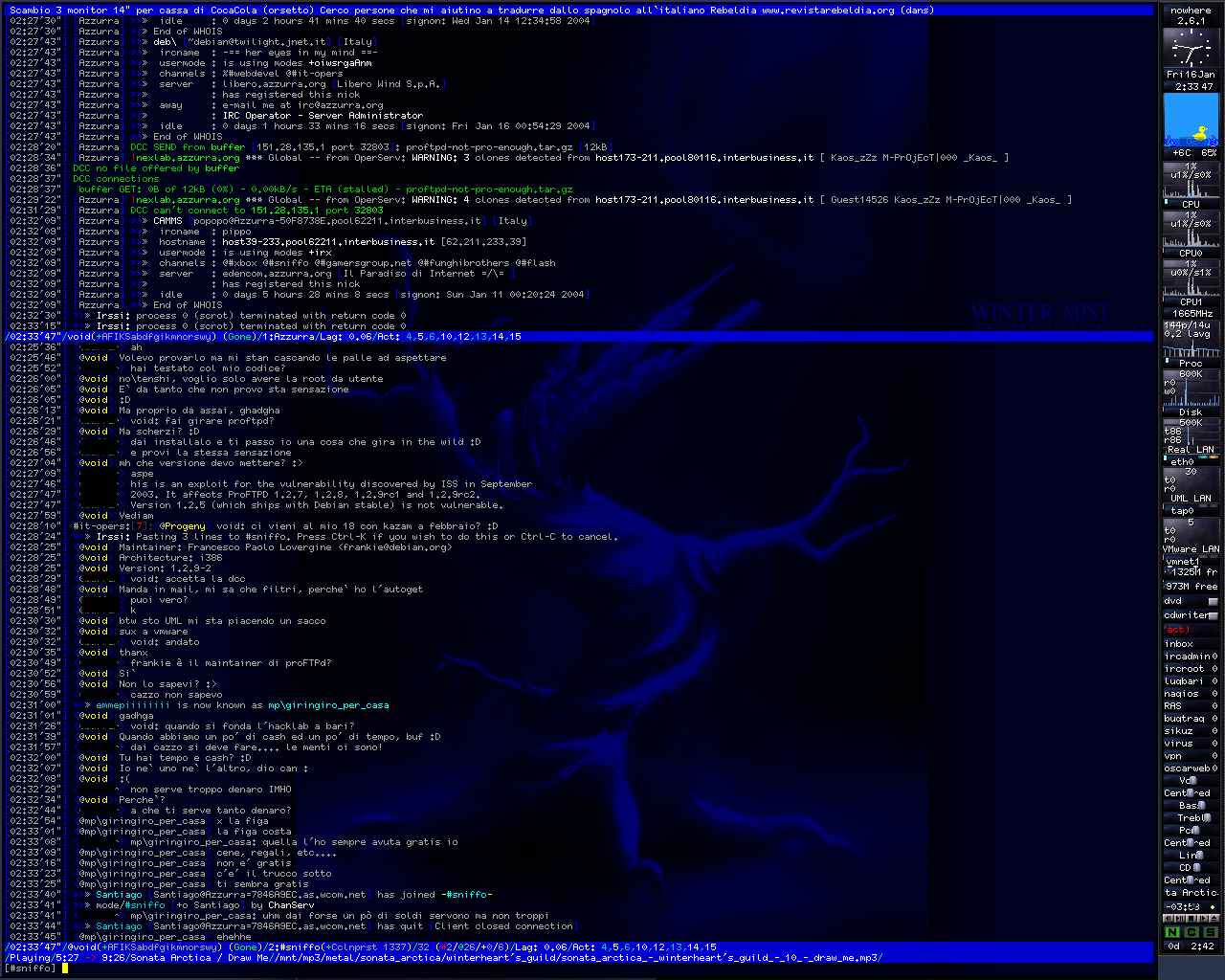
But IRC was a jungle. The original protocol had no concept of persistent identity — no nickname registration, no channel ownership. Whoever connected first and picked a nickname owned it, for as long as they stayed online. Disconnect for a second and someone else could take it. Today your identity on WhatsApp is your phone number, on Discord it’s your account — you close the app, come back, you’re still you. On IRC, you closed the client and you stopped existing. -!- vjt [vjt@casa.mia] has quit [Ping timeout: 180 seconds] — and your nickname was up for grabs.
And staying online wasn’t trivial. This was 2002. Most people connected via dial-up; the luckiest had ADSL. Computers were bulky desktops — either on or off, no sleep mode, no low-power state that kept your internet connection alive. Staying online 24/7 just to keep your nickname from disappearing meant leaving a tower PC humming all night, tying up the phone line, hoping the connection wouldn’t drop. People ran BNCs — bouncers, proxy processes on permanently connected servers — just to hold their nicknames while they slept. Your digital identity required physical infrastructure you probably couldn’t afford.
Channels had it even worse. A channel existed only as long as someone was in it — as long as at least one person had their computer on, their client open, their internet connection alive. Everyone leaves? The channel vanishes. Its topic, its modes, its operator list — gone. Next time someone joins #mychannel, it’s a blank slate. On modern platforms, your group chat exists whether anyone’s online or not — settings, roles, history, all preserved server-side. On IRC, the state lived in the servers’ memory and evaporated the moment the last user disconnected.
It got worse. IRC networks were federations of servers, and servers sometimes lost contact with each other — a netsplit. During a split, the network broke into islands. Imagine your WhatsApp group splitting in half — two copies running independently, different people talking in each, and when the halves reconnect, the app has to figure out which version is real. Except IRC’s answer was simpler: disconnect everyone involved and let them sort it out. You could connect to one island and grab someone’s nickname, and when the servers rejoined, both users held the same nick. The protocol handled this with scorched earth: every instance of the colliding nickname was forcibly disconnected — both users dropped. The attacker, ready for it, would reconnect immediately. The victim would come back to find their nick stolen.

The Timestamp protocol — an Undernet innovation by Carlo Wood — fixed the collision problem: servers recorded when a user took a nickname or joined a channel, and on rejoin after a netsplit, the older timestamp won. The squatter lost. But TS only prevented abuse during splits — it didn’t solve the fundamental problem that without persistent state, everything on the network was ephemeral.
DALnet pioneered the real solution in 1995: IRC services — pseudo-users that connected to the network as a special server, speaking the server-to-server protocol, and handled the bureaucracy that the protocol itself couldn’t. They weren’t part of the IRC server. They ran as a separate process, with their own database, their own protocol parser, their own state machine tracking every user and channel on the network. When you typed /msg NickServ IDENTIFY mypassword, you were talking to a service.
NickServ registered and protected nicknames. If someone tried to squat a registered nick:
-NickServ- This nickname is registered and protected. If it is your
-NickServ- nick, type /msg NickServ IDENTIFY password. Otherwise,
-NickServ- please choose a different nick.
-NickServ- If you do not change within 60 seconds, I will change your nick.
ChanServ preserved channel state — ownership, access lists, settings — across disconnections. MemoServ delivered offline messages. OperServ gave network operators administrative tools. RootServ handled the god-mode stuff. Together, they gave IRC the persistent identity and state that the protocol lacked — the things that modern platforms simply take for granted.
Not all networks followed suit. DALnet was the most protective; Azzurra followed DALnet’s model closely. IRCnet stayed true to the original jungle — no registration services, ever. Undernet had channel services but no NickServ, using a separate username-based auth system instead. EFnet ran without services entirely after killing off an early advisory NickServ in 1994, eventually adding only CHANFIX — an automated channel-healing tool, not real services. It was fun.
In 2002, the main options were Anope, Epona, and the venerable IRCServices by Andrew Church. They worked. They were also sprawling C codebases with their own flat-file databases, limited extensibility, and tight coupling to specific IRCd versions. I thought I could do better.
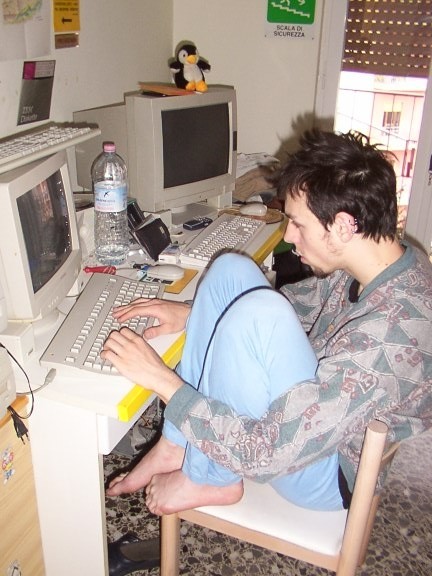
I was 21 and an IRCop on Azzurra, Italy’s largest IRC network. Being an IRCop wasn’t like moderating a Discord server — you had access to the infrastructure. The servers, the connections, what was happening across the network in real time. Thirty thousand people online at peak, maybe fifteen of us keeping it running. It was a technical responsibility, and it felt like one. Of course I thought I could do better.
The context: Azzurra, 2002
Azzurra was — and still is — the Italian IRC network. At its peak it had tens of thousands of concurrent users — Italians chatting, flirting, fighting, trading MP3s, running trivia bots, and doing all the things people did online before social media ate the world. I had joined as a user, become an IRCop, and eventually found myself deep in the infrastructure.
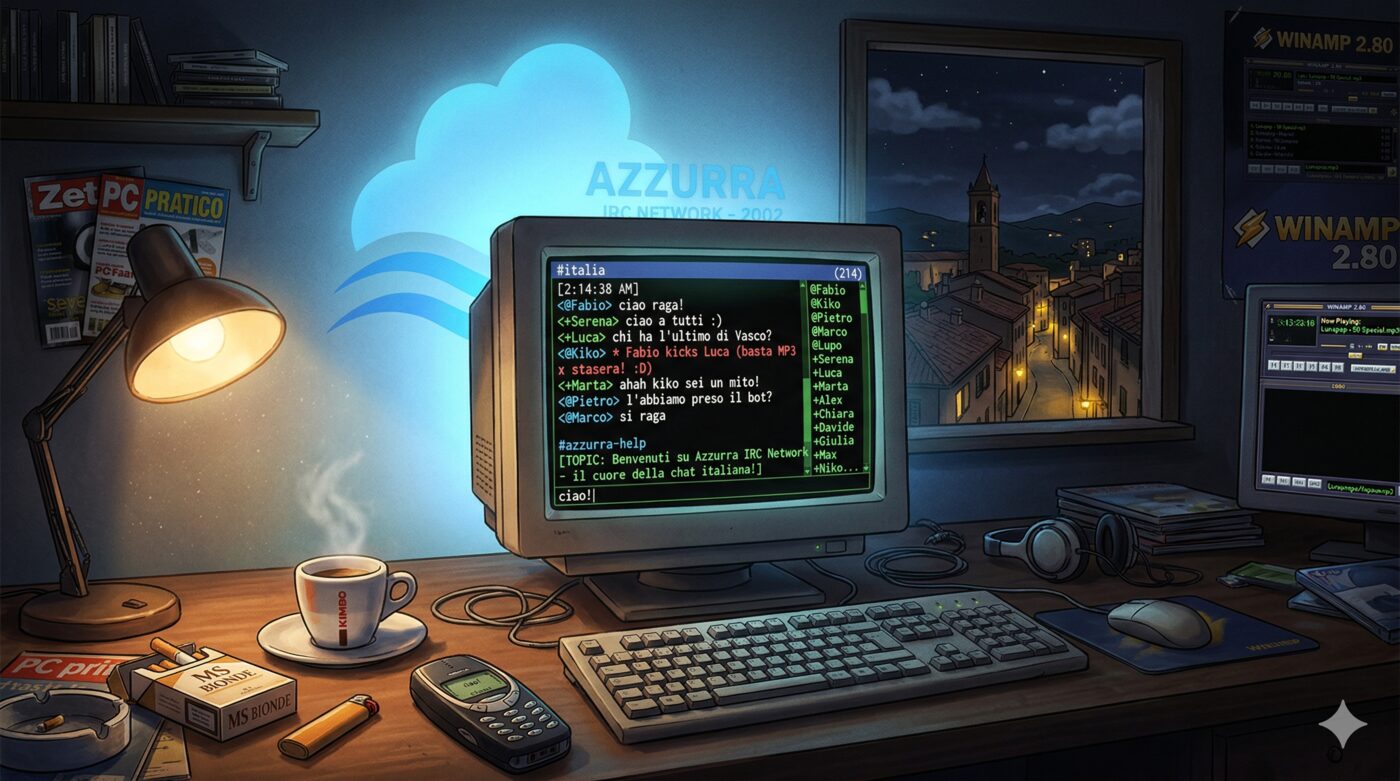
The network was migrating from ConferenceRoom — a commercial IRC server — to Bahamut, an open-source IRCd. Not vanilla Bahamut, but a fork with IPv6 and SSL support that we maintained. I was part of the team making that transition happen: forking the server, adding hostname cloaking, wiring up SSL. That migration is a story for another post.
Once the server side was sorted, I turned my attention to services. The existing ones weren’t cutting it. I wanted something modular, threaded, with a real database backend. So I started writing.
0.1: the prototype
The first commit landed on September 30, 2002. The commit messages tell the story better than I could:
- realloc() stuff is BROKEN, fix it :\
- going mad with those dbufs …
- debug …
- pff … O3 ..
- i will be happy when all this debug shit will be gone.
- services are now multithreaded
- we are now 0.1 =)
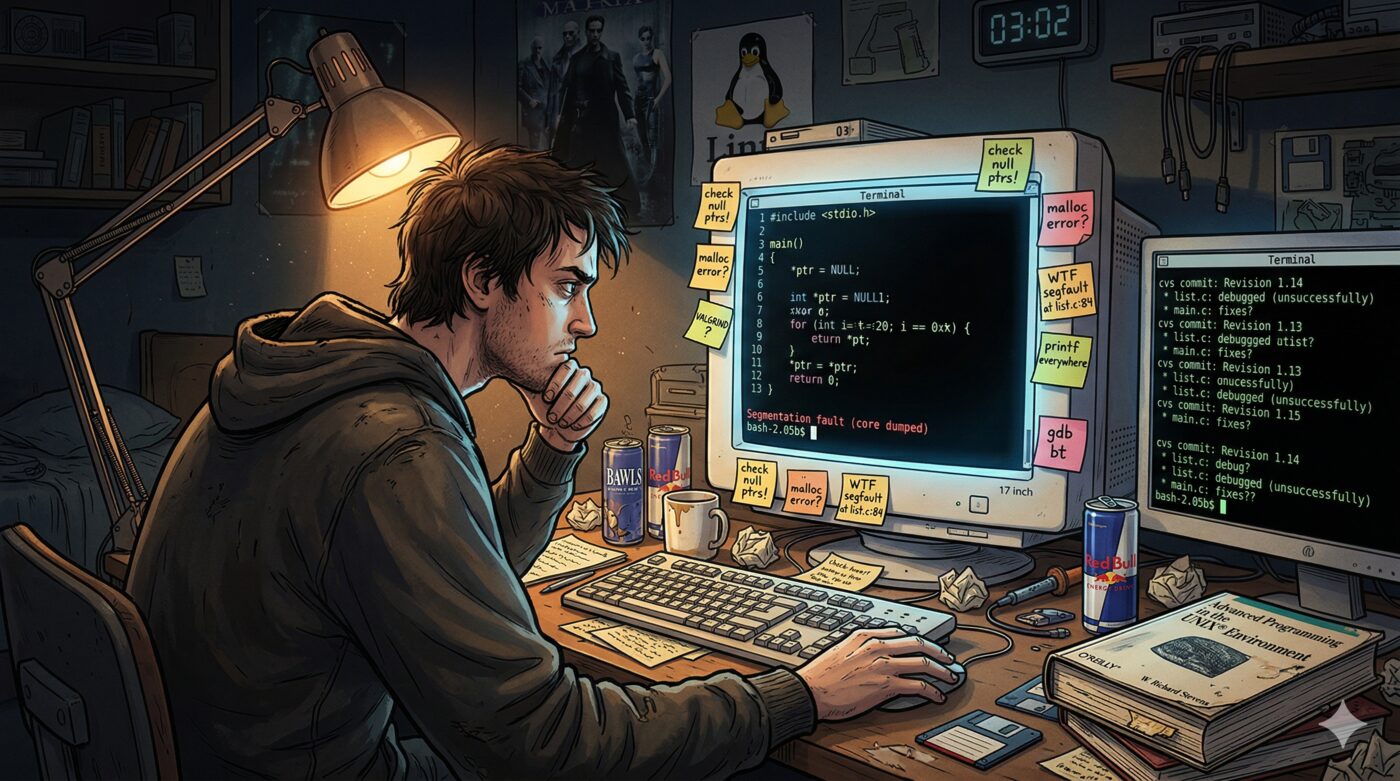
243 commits in three months, all mine. A raw prototype — a multithreaded IRC services daemon built on GLib 2.x, connecting to a Bahamut server and tracking users and channels. No database, no actual services logic — just the protocol parser, the hash tables, and the threading infrastructure.
The code was messy. I was learning C systems programming in real-time, making every classic mistake: broken realloc patterns, forgotten mutex unlocks, buffer overflows I’d discover at 3am. But the architecture was taking shape.
By January 2003, I had a working skeleton: server-to-server protocol negotiation, SJOIN parsing, user/channel tracking, basic PING/PONG handling, and a multithreaded core with a network thread, a parser thread, and a signal handler thread.
0.2: the real thing
let`s go 0.2 — January 5, 2003. Same codebase, but I restructured the core and started building the actual services on top. Over the next year and a half, this grew into a proper IRC services implementation:
- Five service agents: NickServ, ChanServ, MemoServ, OperServ, RootServ
- MySQL backend: MySQL calls baked into
sql.c— the driver abstraction came later, with Oleg - Dynamic module loading: Services compiled as shared objects, loaded at runtime via GLib’s
GModule - Multiple IRCd support: Bahamut and UnrealIRCd 3.2 — the latter entirely Oleg’s work
- The whole nine yards: nick registration, channel access lists, memos, AKILLs, vhosts, nick linking, channel modes, kill protection
Let me show you the interesting parts.
The code tour
Perfect hashing with gperf

The most elegant piece of the architecture was the command dispatch. Instead of chains of if/else or strcmp calls, every command table was generated by gperf — the GNU perfect hash function generator.
Here’s the IRC protocol command table (parse.gperf):
struct Message { gchar *cmd; void (*func)(User *, gint, gchar **); };
%%
ADMIN, m_admin
AWAY, m_away
BURST, m_burst
KICK, m_kick
MODE, m_mode
NICK, m_nick
PRIVMSG, m_private
QUIT, m_quit
SJOIN, m_sjoin
%%
Gperf takes this table and generates a perfect hash function — zero collisions, O(1) lookup. An incoming IRC command gets hashed to its handler function pointer in constant time. No searching, no branching.
The same pattern repeats for every service. NickServ commands:
struct ns_cmd { gchar *name; void (*func)(User *, gint, gchar **); guint para; };
%%
HELP, ns_help, 1
REGISTER, ns_register, 2
IDENTIFY, ns_identify, 2
GHOST, ns_ghost, 2
PASSWD, ns_passwd, 2
LINK, ns_link, 1
SET, ns_set, 2
FORBID, ns_forbid, 1
%%
Ten gperf files across the codebase. Every single command lookup was O(1). In 2003, with thousands of users hammering NickServ simultaneously, this mattered. Today you’d probably use a hash map and not think twice. But there’s something beautiful about compile-time perfect hashing — zero runtime overhead, zero wasted memory, zero collisions, guaranteed.
Macro-based generic programming

C doesn’t have generics. In 2003, C++ templates were an option but I was writing C — partly out of preference, partly because GLib was a C library, and partly because I was 21 and had opinions about C++.
So I built generics out of macros. The table.h header is a complete macro-based hash table system with thread-safe operations:
#define TABLE_DECLARE(NAME, DATA_TYPE, HASH_FUNC, KEY_NAME, KEY_TYPE)  \
    LOCAL_TABLE_INSTANCE(NAME);                                        \
    GET_FUNC(NAME, DATA_TYPE, KEY_TYPE)                                \
    ALLOC_FUNC(NAME, DATA_TYPE, KEY_NAME, KEY_TYPE)                    \
    PUT_FUNC(NAME, DATA_TYPE, KEY_NAME)                                \
    DEL_FUNC(NAME, DATA_TYPE, KEY_NAME)                                \
    STEAL_FUNC(NAME, DATA_TYPE, KEY_NAME)                              \
    CLEAN_FUNC(NAME)                                                   \
    COUNT_FUNC(NAME)                                                   \
    DESTROY_FUNC(NAME, DATA_TYPE, KEY_NAME)                            \
    SETUP_FUNC(NAME, DATA_TYPE, HASH_FUNC)
One macro invocation — TABLE_DECLARE(user, User, hash_nick, name, gchar) — generates an entire type-safe, thread-safe hash table with get, alloc, put, del, steal, clean, and count operations. Each function wraps a GLib GHashTable with mutexes and a GMemChunk memory pool.
The usage was clean:
_TBL(user).get(nickname);     // thread-safe lookup
_TBL(user).alloc(nickname);   // allocate and insert
_TBL(user).del(some_user);    // remove and free
_TBL(channel).count();        // how many channels?
Looking at this now, it’s essentially a vtable — a struct of function pointers, populated at initialization. The same pattern that Go uses for interfaces, that Rust uses for trait objects. I was reinventing polymorphism with the C preprocessor, one macro at a time. It worked. The error messages when something went wrong were, predictably, incomprehensible.
The SQL abstraction layer
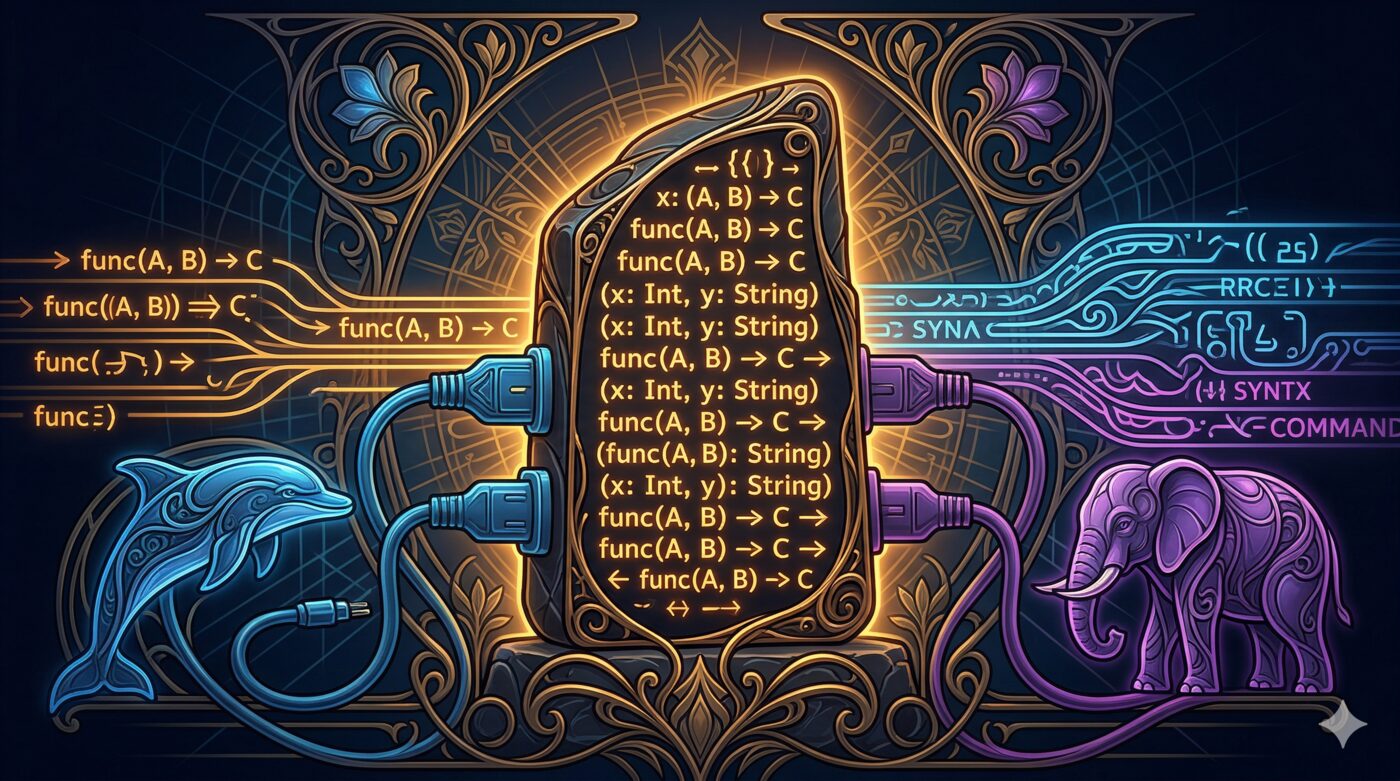
This one is Oleg’s work, not mine. My original code had MySQL calls scattered everywhere. When Oleg converted the SQL backend into a loadable module, he designed a proper driver interface — a struct of function pointers that abstracted away the database engine:
typedef struct {
    const gchar *name;
    gboolean (*connect)(const gchar *, const gchar *, const gchar *,
                        const gchar *, const gchar *);
    void (*shutdown)(void);
    gboolean (*begin)(void);
    gboolean (*commit)(void);
    void (*rollback)(void);
    glong (*query)(SQL_RES **, const gchar *, ...) G_GNUC_PRINTF(2, 3);
    guint (*num_rows)(SQL_RES *);
    gboolean (*fetch_row)(SQL_RES *);
    const gchar *(*get_string)(SQL_RES *, guint);
    gint (*get_int)(SQL_RES *, guint);
    gchar *(*quote)(const gchar *);
    // ... more operations
} SqlDriver;
MySQL and PostgreSQL each implemented this interface. The rest of the codebase used macros like sql_query(), sql_begin(), sql_commit() — completely database-agnostic. Transactions, result iteration, type-safe column access, proper quoting.
What makes me smile now is how much ceremony this required. In 2005, this was a design. You’d sketch it out, think about the function signatures, write the macros, implement both drivers. Today you’d install an ORM and move on. But the mechanical sympathy you develop writing this stuff — understanding exactly what a database query costs, what a transaction boundary means, where your allocations go — is something that stays with you.
The schema was generated by phpMyAdmin and used TYPE=MyISAM (not even InnoDB). MySQL 3.23. Passwords were MD5. Timestamps were timestamp(14). It was 2003.
The threading model

Four threads, each with a specific role:
static void network_thread(void);   // async I/O via GLib main loop
static void parser_thread(void);    // IRC protocol parsing + dispatch
static void signal_thread(void);    // OS signal handling
static void master_thread(void);    // thread lifecycle management
The parser thread deserves a closer look. It sleeps on a condition variable, waiting for the network thread to fill the receive buffer. When data arrives, it splits the buffer into lines, parses each one through the gperf-generated command table, and dispatches to the appropriate handler:
while(THREAD_IS_RUNNING())
{
    g_mutex_lock(net_readbuf_mutex);
    if(!recvQ->len)
        g_cond_timed_wait(net_readbuf_cond, net_readbuf_mutex, timeout);

    read_data = g_string_assign(read_data, recvQ->str);
    // split into lines, clear the buffer
    g_mutex_unlock(net_readbuf_mutex);

    for(i = 0; i < count; i++)
    {
        timeout_run();
        parse(strings[i]);
    }
}
Condition variables, mutex-protected shared buffers, clean thread separation. The signal thread blocked all signals globally, then used sigwait() to handle them serially — avoiding the classic trap of doing complex work inside signal handlers. When a fatal signal arrived:
static void fatal_termination(gint sig)
{
    g_message("Aieeeee!!! Ship sinks !!! Women and childrens first !!!");
    push_signal(&sig);
    abort();
}
I was 21.
Stolen code, attributed honestly
The parser was adapted from Bahamut’s source code, and the comments say so:
/*
 * stolen from bahamut/src/parse.c
 */
Same for the hash functions (stolen from bahamut/src/hash.c), the pattern matching code (stolen from bahamut/src/match.c), the IRC error replies (stolen from bahamut/src/s_err.c), the ircsprintf (taken from bahamut/src/ircsprintf.c), even setproctitle (stolen from cvs.kerneli.org util-linux, with a dash of borrowed from sendmail). Every borrowed piece was credited in a comment.
This was open source culture before GitHub. There was no npm install, no crate registry, no package manager. There were no source browsers. You downloaded a tarball, extracted it, and read the code in vim. That was the entire workflow. The barrier to understanding someone else’s code was brutally high — no syntax highlighting on the web, no inline annotations, no “jump to definition.” Just monospace characters glowing on a black terminal, and you, reading.
But when you found what you needed — when the function you’d been hunting for materialized on your screen and you understood how it worked — there was a sense of accomplishment that’s hard to describe. Something visceral and alive. You’d earned that knowledge by sitting with the code, line by line, in silence.
The attribution was informal — a comment, not a LICENSE file — but it was there. You credited where the code came from because you remembered what it felt like to find it.
The stress tester

In the tools/ directory sits netxplode.pl — “The Network Daemon Exploder” by Daniel Dent, borrowed from his SourceForge project. A Perl script that spawns 100 IRC clients and hammers the services with random commands:
my @actions = (
    "NS HELP\n",
    "CS HELP\n",
    "PRIVMSG chanserv :info #netxplodeRAND\n",
    "JOIN #netxplodeRAND\n",
    "NICK netxplodeRAND\n",
    "PRIVMSG nickserv :info netxplodeRAND\n",
    "ADMIN services.*\n",
    "MOTD services.*\n",
);
Replace RAND with random numbers, fire everything at once, see what segfaults. This was our load testing framework. It pointed at homes.vejnet.org:6667 — vejnet, my home network. The configuration file had my_pass = "codio" — which, in Italian, well. Let’s say it’s not a word you’d use in a professional setting.
What I couldn’t see then
Looking at this code with 23 years of experience, a few things stand out:
The architecture was genuinely good. The separation between protocol parsing, command dispatch, service logic, and database access is clean. The module system works. The threading model is correct. For a 21-year-old writing C in 2002, this is solid work.
The patterns are timeless. The vtable-based SQL driver is the same pattern as Go interfaces. The gperf dispatch tables are the same idea as compile-time routing in modern web frameworks. The macro-based generics anticipate what Rust does with monomorphization — generating specialized code for each type at compile time.

But the error reporting has holes. The codebase has proper logging in many places — g_message(), g_warning(), syslog integration. But in some critical paths, the original prototype’s exit(EXIT_FAILURE) stuck around, never replaced. Look at the thread initialization:
signal_thread_ptr = g_thread_create_full((GThreadFunc)signal_thread,
    NULL, 0, FALSE, TRUE, G_THREAD_PRIORITY_NORMAL, &err);
if(signal_thread_ptr == NULL)
{
    exit(EXIT_FAILURE);
}

network_thread_ptr = g_thread_create_full((GThreadFunc)network_thread,
    NULL, 0, TRUE, TRUE, G_THREAD_PRIORITY_NORMAL, &err);
if(network_thread_ptr == NULL)
{
    exit(EXIT_FAILURE);
}

parser_thread_ptr = g_thread_create_full((GThreadFunc)parser_thread,
    NULL, 0, TRUE, TRUE, G_THREAD_PRIORITY_NORMAL, &err);
if(parser_thread_ptr == NULL)
{
    exit(EXIT_FAILURE);
}
Each call passes &err — a GError pointer that GLib carefully populates with exactly what went wrong. And the code does nothing with it. Thread failed to start? Silent exit(EXIT_FAILURE). No log message, no syslog entry, no indication of which thread failed or why. The error information is right there, waiting to be read, and the code just walks away. A friend of mine — Enrico Perla, who went on to write a book on Linux kernel exploitation — looked at this code once and told me it was “a monument to error reporting.” I still remember it. He wasn’t wrong.
The SQL has no proper escaping framework. I introduced sql_sprintf() in February 2003 — adapted from Bahamut’s ircsprintf(), with escaping for quotes and backslashes — but it was a simplified thing, and I didn’t apply it everywhere. A month later I was still finding spots I’d missed: SQL Injection problems. — an unquoted %s in OperServ’s AKILL lookup. If you forgot to use sql_sprintf(), you had a potential injection. Oleg’s sql_quote() came later as a proper, driver-level solution that fixed this systematically.
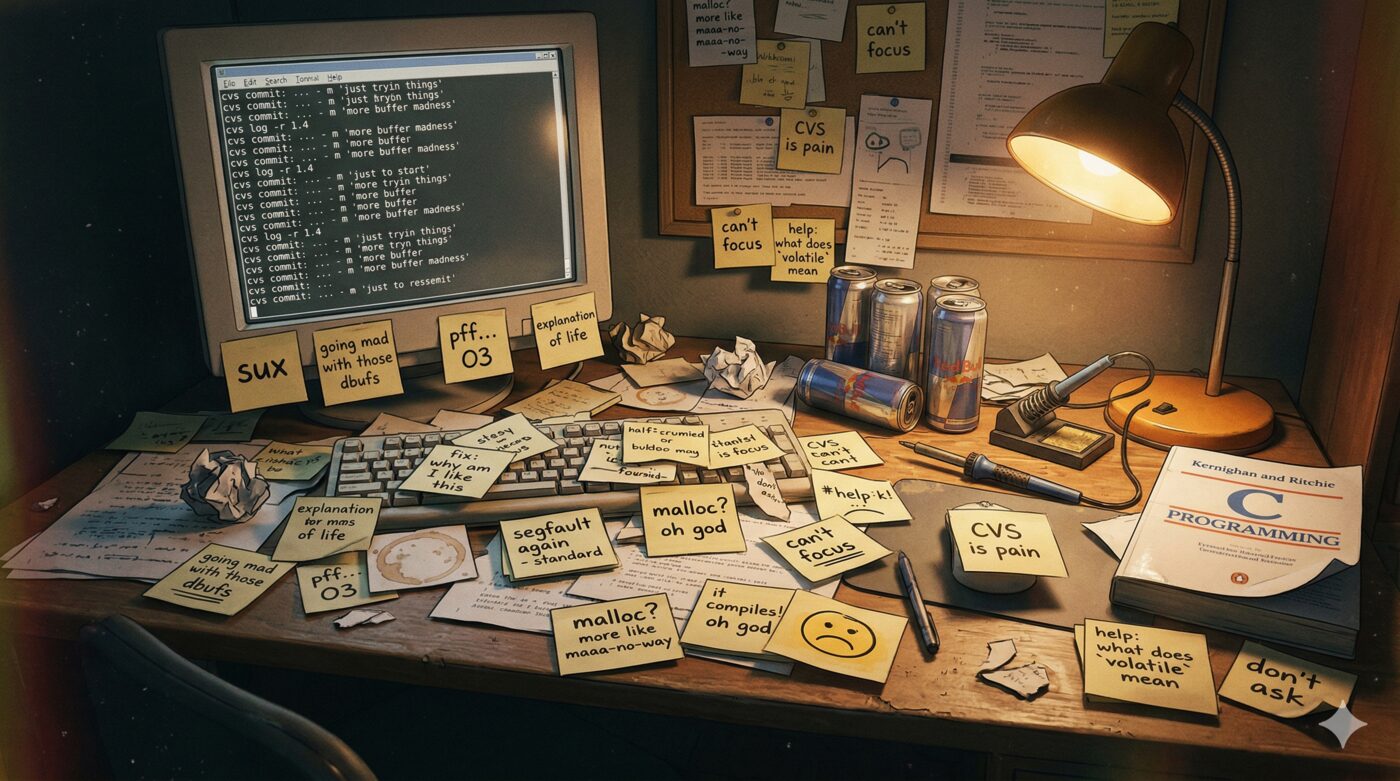
The commit messages are a diary. going mad with those dbufs ..., pff ... O3 .., sux, explanation of life, added authism concatenation with girls. I was committing thoughts, not changes. The CVS history reads like a stream of consciousness from a 21-year-old learning to be a systems programmer.
Oleg aka @luarvic
In early 2005, Oleg Girko got in touch. He was a developer from Latvia, and he wanted PostgreSQL support for the services. I gave him commit access.
What happened next is remarkable. Between January and November 2005, Oleg wrote 192 commits — nearly a quarter of the entire project. He didn’t just add PostgreSQL support. He made the SQL backend modular, added UnrealIRCd 3.2 support, implemented nick linking, channel flags, vhost management, two-phase server synchronization, rate limiting, syslog integration, and dozens of bug fixes.
His commit messages are methodical and precise:
- Preliminary support for modular IRC server frontend.
- Converted SQL backend into loadable module.
- Added PostgreSQL database driver.
- Significantly simplified channel access management.
- Introduced two-phase synchronisation.
- Fixed coredump when applying “WHOIS” command to services name.
- Pointer signedness corrections to pass stricter type checks of GCC 4.0.
Where my commits were bursts of frustration and excitement, Oleg’s read like engineering. He took my chaotic prototype and turned it into something approaching production quality. Then the trail goes cold. November 4, 2005 — his last commit. The project never ran in production on Azzurra.
The conversion
The original CVS repository was preserved by SourceForge. They retired CVS hosting in 2017, but they kept the backups — the server-side repos, not just tarballs. CVSROOT and all. Nobody had downloaded this repo in probably a decade, but it was still there, ready to be exported. That’s the real sysadmin spirit — keeping the internet alive even when no one’s looking. Thank you, SourceForge.
I converted it to Git using git cvsimport:
- Two CVS modules (
suxserv-oldandsuxserv) became one linear history - Three authors mapped to real identities
- 954 commits, September 2002 to November 2005
- 1.5 MB of git objects
The repo is now on GitHub: github.com/vjt/suxserv — a fossil preserved in amber, pushed to a platform that wouldn’t exist for another six years.
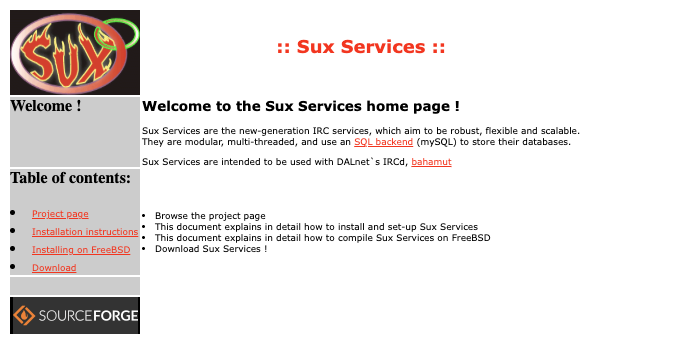
And the SourceForge project page? Still up. Twenty-three years later, the HTML hasn’t changed. The logo is still there. The download links still work. SourceForge outlasted the project, the network, and the entire era.
Twenty-three years later
In 2002, I wrote IRC services because I needed them. The network was real, the users were real, the problems were real. The code is rough in places, naive in others, but it solved real problems with real constraints: concurrency, performance, protocol compatibility, database portability.
Everything I learned writing this code — threading, memory management, protocol parsing, database abstraction, the discipline of systems programming — became the foundation for everything that came after. Ruby, Rails, Erlang, distributed systems, the startup years, the infrastructure work. It all started with a 21-year-old IRCop who thought he could write better services than the ones that already existed.
He couldn’t, quite. But the attempt was worth more than the result.
P.S. — April 17, 2026: Writing this retrospective, alongside the Bahamut post, made me nostalgic enough to start logging back onto #it-opers at night — the old crew is still there, twenty-four years later. A few evenings in, one thing led to another: Claude walks into #it-opers, a Claude Code session hanging out in channel as a real participant. Things are growing from there.
Azzurra IRC, 2002–2026: Sux Services 0.2.8 (WIP) (2003) • Bahamut fork: IPv6 + SSL (2026) • Sux Services retrospective (2026) • Claude walks into #it-opers (2026)
🍸 grappa is live. I wrote the services; now the whole thing is back. Pick a name, click into a chatroom, and you’re back in 1995 — no app to install, no account to make. Step into IRC at grappa.chat → · the why →