This post was written in 2010. It's preserved here for historical purposes — the technical details may no longer be accurate.
🔍
2026 retrospective
CouchDB 0.11 is ancient history — CouchDB 3.x has been the current line since 2020, and the Erlang library layout changed completely. This specific fix is unlikely to apply to any modern installation.
If your CouchDB 0.11 gives you the “Invalid UTF-8 JSON” error on every POST
or PUT you issue to it, make sure that in your
$prefix/usr/lib/couchdb/erlang/lib there aren’t leftovers from previous
installations.
On our dev server, I found there two directories
(“couch-0.10” and “mochiweb-r97”) from the old 0.10 setup that were causing
this issue.
This applies if you upgraded from source, as you’ve probably done, because there
aren’t too many packages of CouchDB 0.11 as of April 2010 :-).
This post was written in 2009. It's preserved here for historical purposes — the technical details may no longer be accurate.
🔍
2026 retrospective
HTML5 Canvas won. Flash was officially killed by Adobe in December 2020. This little speedometer still renders perfectly in every modern browser — but nobody hand-rolls gauge widgets anymore. D3.js, Chart.js, or even pure CSS can do this with a fraction of the effort. Still, 52 stars and 17 forks on GitHub — not bad for a weekend project from 2009. And my friend who wrote the original? He was basically Claude before Claude was a thing — shipping production code at machine speed while the rest of us were still reading the docs.
The <canvas> element is the new shiny thing. Safari and Firefox support it, Chrome just shipped, and Internet Explorer… well, let’s not talk about Internet Explorer. Flash is how you do anything graphical on the web. A friend of mine — one of the most brilliant engineers I know, the kind of person who implements a filesystem overnight and a kernel in a week — shares with me a speedometer gauge widget he wrote as public domain code. It’s cool, but a bit crude. So I take it, refactor the whole thing into proper object-oriented JavaScript, add theming support, work around Firefox’s quirks, and write documentation.
This post was written in 2009. It's preserved here for historical purposes — the technical details may no longer be accurate.
From the stage of Web 2.0 Expo 2008 in San Francisco, Clay
Shirky talks about the social revolution carried by
web 2.0 into contemporary society, from TV to Wikipedia and World of Warcraft.
And twitter still had to be globally recognized, in 2008.
This post was written in 2009. It's preserved here for historical purposes — the technical details may no longer be accurate.
🔍
2026 retrospective
Rails 3.0 shipped in 2010 and the Merb merge was a success. Today Rails is at version 8.x, having integrated everything envisioned here (modularity, stable APIs, engines as first-class citizens) and much more. Lighthouse is gone, therubymine.com no longer exists, and many links in this article are dead — but the core ideas still hold.
Almost every web developer knows or has at least heard of Ruby on Rails, a full-stack framework for building web applications using the Ruby programming language.
The sad conclusion: “humans are such herd animals”
The good conclusion: “virality has always existed, it’s not an invention
of Web2.0. Social networking is just a powerful tool for everyone that wants to
change the world”
The mean conclusion: “how much does it take to get people from their
computers to the real world after a virtual ‘heads up’ by some ‘dancing man’?”
Take the whole social environment, utterly unprepared to the media \(r)evolution happening in the last years, and let the hackers observe and talk/write about it. Bring in the lawyers, and let them recognize that “Houston! We’ve got a problem!”, whilst also they define it via lawspeak. Ask questions, and participate to interesting debates.
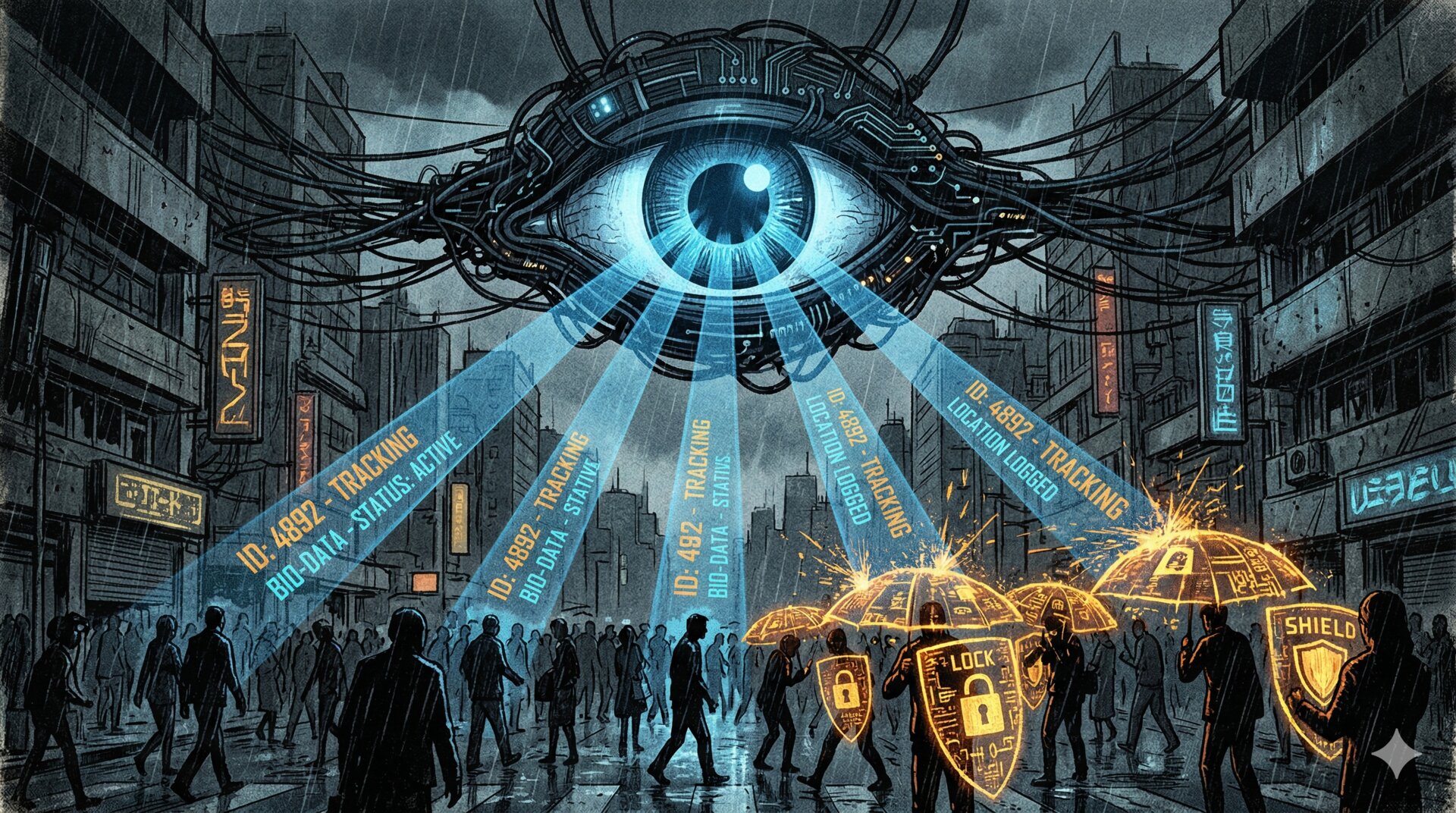
Now, deliver the 2007 big brother award to the Google Representative, let the sun dive in the hills, add a noticeable amount of Tuscany red wine, and get ready for the next day. Let the paranoia flow, while the hackers show how you can be traced and found via the cellular network and spied via wifi-networked cameras placed there for your safety.
Of course kill 222 ; pppd call dsl-provider doesn’t work. YUCK. Let’s put a router in front of it.. configure, portforward, and start over.. then fdisk /dev/hdc to recreate partitions structure on the new hard disk, mkfs.xfs on all the new partitions, mount /dev/hdcX /target, pax -r -w -p e /{bin,boot,dev,etc,home,initrd,lib,media,root,sbin,srv,tmp,usr,var} /target… wait a lot for the copy to complete because of damaged sectors on the source hard disk, chroot /target, vi /etc/lilo.conf and substitute boot=/dev/hda with boot=/dev/hdc, run lilo -v while in the chroot verify /etc/fstab, and finally shutdown to remove the faulty disk, and boot again.. restoring lilo.conf. yay!
This post was written in 2009. It's preserved here for historical purposes — the technical details may no longer be accurate.
«Women! The knife grinder is here!» – Apart from funny jokes ;) the italian Apple Store together with Girl Geek Dinners Roma organized on May 16, 2009, a workshop about mobile lifestyle (focusing on the iPhone, of course).
Let’s start from the beginning: what are the Girl Geek Dinners? Linda explained to the audience (nearly 20 people) that a geek is a person passionate about technology in a broader sense: the GGD is a group devoted to aggregate women interested about the internet, new medias and technologic lifestyles. Women are often underestimated in geek communities, and this embarassing clichè generated a lot ofdiscussion in the past, and it’s still unsolved (in my opinion).
The GGD italian group was born in 2007 in Milan, and then arrived to Rome in 2008, and is also present in Bologna and in the Marche and Emilia-Romagna states.
So, the GGD group tries to generate a “critical mass” of geek women, to abolish a stereotype that “computer programmers / power users” are only men: in GGD events boys listen and girls talk, then they blog, exchange vCards (and PGP keys, I’d guess ;) and in general try to harness women power and skills in the field of the computer industry. Networking and a dive into social media is the most efficient way nowadays to reach a great audience, and to build rapidly the aforementioned critical mass: that’s why the GGDs event was focused on social mobile applications and general productivity ones. Presented by two official Apple Trainers (Simona and Riccardo), the workshop started @11.30 AM and lasted nearly one hour.
This post was written in 2009. It's preserved here for historical purposes — the technical details may no longer be accurate.
🔍
2026 retrospective
Much has changed since 2009. The Caio Report’s promise of 99% broadband by 2011 never materialized — Italy still struggles with digital divide issues in 2026. Fastweb was acquired by Swisscom. Tre and Wind merged into WindTre. Tele2 exited the Italian market entirely. The P4P protocol never took off. Deep Packet Inspection became far more widespread than anyone feared, now standard kit for surveillance states worldwide. Paolo Gentiloni became PM of Italy and later EU Commissioner.
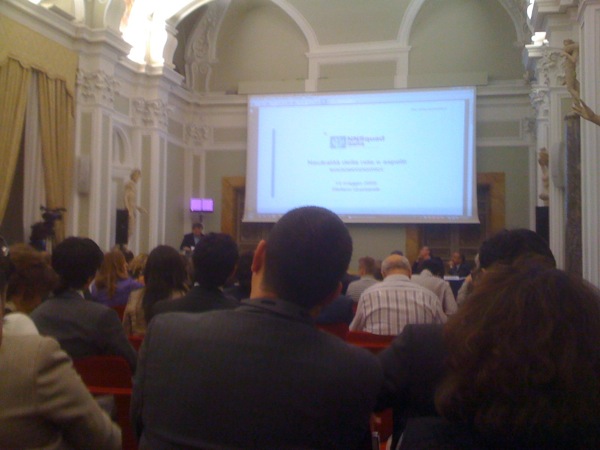
This is the second part of my recap of the nnsquad.it convention held in Rome on May 14,
2009, and hosted by the ICT consultants foundation Fondazione Ugo Bordoni.
In the first
part I described the morning session, dedicated to the definition of
Network neutrality, and how global economics can cope with it. The afternoon
was dedicated to more technical talks, and I had the occasion to hear telcos
spokesmen remarks over the current situation and possible future
developments.
The first speech started at 2.15PM and was held by
Prof. Vittorio
Trecordi (slides available here). He
introduced it by stating that net neutrality could possibly contrast with the
economic development and security assessment, because of the wiretapping needed
for the latter, tap that is strongly against the individual freedom to
communicate.
Strangely (or maybe not) enough, no mention was made to current ways to
bypass both wiretapping and localization of communicating peers: I’m
referring to the tor project, the most known
bastion that guarantees privacy and is currently used by
journalists working in "hot" areas, among many others.
This post was written in 2009. It's preserved here for historical purposes — the technical details may no longer be accurate.
🔍
2026 retrospective
The EU adopted strong net neutrality rules in 2015 (Regulation 2015/2120), largely vindicating the principles Quintarelli advocated here. In the US, the FCC’s 2015 Open Internet Order was repealed in 2017 under Ajit Pai, and the debate still rages. Most of the links in this post are dead. Stefano Quintarelli went on to serve in the Italian Parliament. Paolo Gentiloni became Prime Minister of Italy (2016–2018) and EU Commissioner for Economy.
The preface looked pretty good: technicians, Ph.Ds,
telco spokesmen and politicians speaking about the internet, its inborn
freedom, and how to cope with this in a society where security measures are constantly increasing, and as such
contrast in a virtual world with no barriers whatsoever. Furthermore,
it’s a virtual arena in which everything can be free, not only information, and people are
becoming accustomed to it.
The first speech was held by prof. Kenneth Carter, directly from the
columbia university, and served as a broad introduction about the matters that
were explored (and sometimes repeated) through the day. In a nutshell, the big
question is: might ISPs offer different degrees of performance over different
sites (or charge for better performances), permit/block/surcharge access to
certain sites or via certain devices?